Wednesday, November 24, 2010

Webcomics Wednesdays!

So Nick came up with the idea of linking to a different webcomic each Wednesday as a way of promoting an aspect of graphic literature that libraries tend to overlook. (It's not so much that we don't like them, it's that we can't really take credit for people reading comics on the internet. Dirty library secret!)

Anyways, when I heard the word "webcomics," I was like, "oh! Me! Got it! I'm writing that!"

So now that's what I'm doing I guess.

For this inaugural edition, here's a classic. It pretty well captures the creative freedom of webcomics. Freedom, that is, to use the exact same drawings every time.

That's right, it's Ryan North's Dinosaur Comics:


The obvious beauty of Dinosaur Comics is that the drawings are awesome. Microsoft Paint dinosaurs have never looked better (unless the girl who writes Hyperbole and a Half did a drawing of dinosaurs at some point.)

So if you're a guy who just happened to make the best MS Paint drawings of dinosaurs ever, what do you do? Well first of all you never draw anything else ever again. And then you keep re-using those images until the internet has memorized every pixel.


Basically, these are the only characters. T-Rex shouts things in declarative sentences, Dromiceiomimus kind of plays along, and Utahraptor points out the flaws in T-Rex's aforementioned declarative sentences. Sometimes God talks to them (as indicated by boldfaced text and a word bubble leading off-panel). The predictability of the format forces North to script these things pretty creatively, though.


Basically, it's one of the best things on the internet.

(Quick Warning: as with most things on the internet, there's some content that's inappropriate for younger audiences. View at your own risk!)

Dinosaur Comics by Ryan North

Next week: other best things on the internet!

Thursday, November 18, 2010

V for Vendetta by Alan Moore


V for Vendetta was brought into most people's consciousness, including mine, from the 2006 film adaptation done by the Wachowski brothers. It seems to be a reactionary and angry graphic novel inspired by the extreme conservatism of Thatcherian politics of the 1980s. V for Vendetta features our hero V who wears a Guy Fawkes mask and has a penchant for theatrics. He meets a young lady named Evey who has experienced dystopian Britain's oppressive government for too long. V takes her under his wing and explosions, murder, and anarchy ensue.

Here are the discussion questions and answers. SPOILERS BELOW!

1. Alan Moore is all about his superhero deconstruction. Is V a "superhero" in the comic sense?

V is in some ways a superhero. He is only an idea, it doesn't matter who is behind the mask, only his ideals. So in this way he is much like say Spider-Man or Batman. Their identities are secret, but it is known that they stand for honor and goodness and such. He is also like other superheroes in that his morals are questioned. In some of the better Batman stories, the writer asks the reader if his actions are truly justifiable. Many of these moral dilemmas are peppered throughout V for Vendetta as well.

2. V for Vendetta is set in a post-apocalyptic and/or dystopian future. Is this a believable setting given the circumstances of the 1980s England that Alan Moore lived in?

George Orwell, Alan Moore, and a host of 1950s science fiction authors always make the mistake of setting a dystopian future in the very near future. Sure Margaret Thatcher said some scary things, not discluding what she apparently jokingly said about putting homosexuals in concentration camps. However, V for Vendetta is a worst-case scenario kind of paranoid theory that could only come out of Alan Moore's crazy hermit head.

3. David Lloyd draws Evey differently in each book of V for Vendetta. Why? What do each of these physical likenesses represent?

There are a few Eveys. The innocent and naive Evey, the grotesque and wrinkly bald Evey, the inexplicably 50s styled Evey with short curly hair, and Evey as V. David Lloyd drew Evey very grotesquely during her transformation to show that she was suffering and that her transformation did not come easily. The other likenesses, I'm not sure if they had any significance. Thoughts?

4. What is the significance of the smile on V's mask and the resulting unchanging exterior?

V always has that coy smile no matter what he says or feels. This mask shows confidence all the time; it adds to the mystique that V uses to become more than a man, to become an idea. There's the great panel near the end where Evey has a very V-like smile when she finally understands V's point of view and has become "freed."


5. What is the importance of flowers? Dominoes?

The flowers represent a better time, before the nuclear war and fascism caused rationing and extinction. If you want to get really high school English on the subject, flowers bloom and it could be said that V wants England to bloom, to rise above the totalitarian leadership they are currently under. The dominoes reminded me of the Domino Effect, a term used to describe the spread of communism. If one country fell to communism, then so would the rest. Perhaps the dominoes were like a backwards version of that. If V's carefully placed plans went through, he could knock the totalitarian government down all at once.

6. V for Vendetta is heavily based on British politics. Does the political message still make it through despite cultural and generational differences?

The Wachowski brothers film tried to address this issue, making V for Vendetta a Bush-era political satire. Personally, it didn't come through for me. I think Moore's political message makes it through the comic, it is just not as personal here in the United States. For example, there are not nearly as many security cameras on the streets here in the U.S. as there are in England.

7. What are the similarities and differences between V and Rorschach from Watchmen?

V's mask and Rorschach's mask both represent their worldviews. Rorschach's black and white mask represents absolutes; in his mind a person is either good (on his side) or evil (preparing to die by his hands). V's mask represents Guy Fawkes and has a coy little smile all the time. This represents his aversion to the British government, his love for theatrics, and the smile is his feeling towards it all: happy but destructive. The difference? Rorschach is driven by darker forces, his awful upbringing, his masochistic need to kill while V is driven by hope, he truly wants his actions to bring forth a better England.

8. In the technical sense, V is a terrorist. Is terrorism a legitimate way to overthrow an oppressive government? Is it the only way? Were the fatalities likely caused by V's explosions worth the ultimate result?

This is quite a debate here. V's plan to overthrow the government was essentially to take down each part of the regime (ear, eye, nose, mouth, fingers) to instill fear and uncertainty both in the general public and in the government. However, he also caused quite a few explosions that could very well have caused some innocent casualties. Were these innocent deaths worth the end result? Were the citizens of dystopian Britain really "living" in the totalitarian regime? I'm just raising more questions here. I'd love to hear some feedback on this one.

9. V seems to have an obsession with theatrics. Why? How does this play into his persona or philosophy?

V's obsession with theatrics is what makes him such a great "character." (Only a character in the technical sense. Yes, he's an idea.) V is constantly quoting Shakespeare and popular songs while he gleefully murders members of the government. This is never really explained and I never got an idea as to why V chooses to act this way. Perhaps it plays into the coy smile that is plastered on his face? He happily conducts while the Parliament building explodes, perhaps this is just his way.

10. The citizens of dystopian England were under constant watch by cameras. How does this effect people? How do people act when they are on camera? How did this voyeurism effect the men and women who watched the monitors?

Clearly, the population of England in this graphic novel have been beaten down into lives that constantly feel the burden of an oppressive government. People cannot do anything "illegal" as decided by the government, so these people are shells. As soon as the cameras turn off, a school girl graffitis a nearby wall. People need to act on instinct and sometimes do deviant things, it is a part of human nature. The voyeurism on the other side deeply effected the leader, who fell in love with Fate the computer perhaps because it was the only thing in the world that could tell him what to do or had more power than him.

11. What is the importance of V's mask? Could he have done the same things to England if he had been unmasked?

V's mask is important obviously in hiding his identity since he's an enemy of the state, but it is also so he can become more than a man. The mask represents V's ideals, if he had just been a man people would have been less likely to listen.


12. What's the significance of the motto "strength through purity, purity through faith?"


Elena helped us work backwards on this one. Faith is believing in something, and purity is cleansing one's self to in theory become a better person. So this statement says having the strength to believe in something that may not make sense(fascist government) makes you a better person. Totalitarianism personified.

13. Why did V kick Evey out of the Shadow Gallery initially?

Evey was not ready; she was questioning who V was, thinking that he was her father. V needed to kick her out so she could experience the real world again and realize that it does not matter who V is, the only thing that matters is what he represents, what he stands for.

14. Why does V let Finch shoot him in the subway tunnel?

V had finished his work. He set up the dominoes and let them fall; every dangerous member of the government had been killed. He needed to allow Evey to carry the torch.

15. What are the differences between old V and the new V? What are each of their responsibilities?

Old V was destructive, he tore fascist England's government apart so new V could rebuild and create a new England.


16. Was Evey brainwashed by V or did she truly embrace V's ideals?


This was a big debate at the book club. Part of the problem is Evey's lack of characterization. It seemed to me that after her "cleansing" by V's hands, she just all of a sudden took on his ideas and ideals without much explanation or thinking for herself. Her speech at the end as V seems robotic and planned. On the other hand, V inspired Finch to become a different person and view England in a different way, so perhaps the same happened to Evey.

17. In the end, is England better off for what V did for them? Will the people be able to run their own government?

Questionable. Governments often run in cycles, so it's possible that England could go from the oppressive regime to a more democratic and freeing government. However, I do not have confidence in Evey's skills of "creating" and showing England how to live. It could be argued that her work is done with her rejuvinating speech at the end, but I think her help would be much more needed in the future.

EXTRA CREDIT from Josh: Why is Natalie Portman in so many comic book/fantasy roles (in Star Wars, in "V for Vendetta," in the upcoming "Thor" movie, in the upcoming "Pride and Prejudice and Zombies"), and yet she's still cool and not typecast yet? What makes her so fitting to be in these roles?

Jeremiah says she has a good agent. Zing! I always assumed that Natalie Portman was just a secret nerd who enjoyed all of these non-traditional film roles. Being in pompous queen and British poppycock films like The Duchess and Pride and Prejudice Without Zombies provide an interesting and stark contrast to upcoming film roles like Pride and Prejudice and Zombies and Thor.

Monday, November 1, 2010

The Walking Dead pilot


For the uninitiated, AMC premiered The Walking Dead last night, a new TV series based off of Robert Kirkman's graphic novels of the same name. We did a book club back in August of 2009 for The Walking Dead, so I figured this is kind of appropriate. One of our gracious book clubbers offered to have a viewing party at her house, but sickness, scheduling problems, and children unfortunately got in the way. However, I'm willing to bet more than a few of us watched it last night, so I'd like to hear some of your thoughts.

Here are some of mine, spoiler-free:

-It feels slow-paced, or methodical you could call it. The first five pages of the first Walking Dead trade is covered in a half hour. I read in an interview with director Frank Darabont that he prefers this approach, and making a TV show allows for this. Judging from other AMC shows such as Breaking Bad and Mad Men, it seems this slow methodical approach is their m. o. I think of all TV shows, The Walking Dead could have benefited from a no-frills, fast-paced, this-dude-is-now-dead-even-though-we-just-met-him approach.

-The zombie effects are great. Maybe some of the other effects, like blood and the pretty obviously computer generated car-filled highway during Rick's lone horseman scene are TV-quality, but the zombies look amazing. The "I'm sorry this happened to you" legless zombie especially was horrifying in the best possible way.

-The dialogue isn't terribly clever. This is a problem in Kirkman's graphic novels, too, but whenever characters have to converse casually, it's painful. Shane and Rick's conversation about durn women who can't turn off the lights would make masters of conversational dialogue like Quentin Tarantino and Kevin Smith cringe.

-Will it follow the graphic novel exactly? The pilot felt pretty safe while Kirkman's graphic novel pulled no punches in any way, which was much of its appeal. Especially in later story arcs like with the Hunters or the Governor, I'm not seeing how AMC could pull those off in the same vein as the graphic novel. According to the previously mentioned interview, Darabont plans to use Kirkman's ideas as a framework, then go in a different direction, but the pilot's strict adherence to the first Walking Dead trade makes me wonder.

Friday, October 15, 2010

Pride of Baghdad by Brian K. Vaughan


Pride of Baghdad is a one-shot graphic novel by Brian K. Vaughan, one of my favorite comics authors partially due to his fine work on Y the Last Man. The graphic novel is based on a true story of a pride of lions who escaped a Baghdad zoo in 2003. Vaughan takes on the challenge of depicting animals like humans while still trying to convey animal thought with varying degrees of success. Pride of Baghdad seems to be a love it or hate it type of graphic novel judging from reviews I've read, so I will most likely be fielding some complaints at this upcoming book club at Koelbel Library on Sunday the 24th at 2:00 p.m. Here are some questions to chew on until then.

1. Many of the one-shot graphic novels we've read lately such as Orbiter, Eternals, and now Pride of Baghdad have ambiguous or abrupt endings. Is this tendency unavoidable due to the nature of a one-shot graphic novel?

Personally, I think this could be the case. As Gaiman mentioned in the afterword for Eternals, he had to add a few issues to the end to get the whole story in and even then the graphic novel felt rushed in my opinion. I'm sure there are some one-shot graphic novels out there that do not have ambiguous or abrupt endings, but this is a hurdle that many authors face.

1a. As Jeremiah has noted in past meetings, Vaughan tends to write abrupt,
ambiguous, or even "gearshift" endings in which he leads one direction then ends on a completely different note. Is this a weakness as a writer or could it be construed as a purposeful style?

Vaughan knows that his m. o. is writing abrupt and striking endings. He clearly has an anti-war stance and it seems likely that wanted to use his style of endings to have one with maximum impact. As Jeremiah noted, Brian K. Vaughan has said himself that he hates happy endings, so this is clearly a purposeful style. I would argue, however, that if he continues to write every story with predictable "unhappy" endings, this could be interpreted as a weakness.

2. There's no avoiding noticing the visual similarities between Hendrichson's art and Disney's The Lion King. Should Hendrichson have avoided the cartoony style? Does the style work for this story?

Some of us were instantly reminded of The Lion King, others like Richard were not at all. It was argued that the style could have purposely been used, again for maximum impact. The comparison between a peaceful life in the wild depicted in the Disney feature versus Vaughan's war-torn desert environment would pull on the old heart strings for sure.

3. Why were the faces of the U.S. soldiers obscured?

Throughout the whole story, there were no human faces. Perhaps this was because it was supposed to be an animal-focused story. The faces of the soldiers were also not important, they are almost a faceless malevolent force to the pride of lions instead of individual humans. Finally, the focus seemed to be on the American flags on their uniforms rather than their faces, so it seemed more important to depict their American origins.

4. Let's say the lions did not come across the herd of white horses in the streets of Baghdad. Should the lions have eaten the dead "keeper" despite the fact that humans were the ones who fed them?

We didn't get to this one during the club. Any thoughts on this? Perhaps eating the "keeper" would have been a turning point. When the lions enter the wild, their previous misconceptions, tendencies, and survival instincts should be completely changed. However, Noor still did not eat the gazelle back in the zoo, so perhaps the pride would have held on to their domesticated survival tendencies.

5. What do the white horses represent?

Nature in a war torn environment. Going the cliche route, they could represent hope. In context, the pride saw that food was indeed available outside of their zoo cages even though they did not end up eating the horses.

6. What is the significance of the horizon? Why haven't the lions seen the horizon?

The horizon was something that the older lions saw when they grew up in the savannah, but haven't seen since in their cages since they are in a cove in the ground. The horizon could have abstractly represented the freedom that the lions were seeking in the first place. The male lion never gets to answer whether it was "worth it" or not, but perhaps escaping the zoo and experiencing the wild and the beauty of nature made the tragedy it led to worth it.

7. The pride of lions opted to leave the zoo once their cage was destroyed. Should they have left despite the fact that leaving caused their eventual end? Would they have met a similar end if they'd stayed?

Clearly can’t continue to live there, they can stay and hope that another bomb doesn’t fall in the same place or travel elsewhere to potential safety. They had no way of knowing that leaving would have caused their deaths, the logical choice was to leave.

8. Noor tries to convince the antelope that predator and prey can live and work together in safety. Is this plausible for animals held in captivity?

The lion’s word was good, they did not eat the antelope. Perhaps this could represent various warring groups in Iraq such as the Kurds and the possibility of living in peace and uniting. Animals held in captivity do likely forget their survival instincts since they do not have to hunt for food. Predator and prey living in peace could happen.

9. The back of the book calls Pride of Baghdad "provocative" and "politically nuanced." Do you agree? What, if any, political message did you take away from the graphic novel?

There was a pretty hamfisted political message in Pride of Baghdad. It clearly has an anti-war and anti-violence agenda. I would not go so far as to say it was nuanced, but some of the underlying messages and symbols were thought provoking.

10. Pride of Baghdad's detractors cite overt sexism between the male and female lions. Did you sense this? If it is accurate in the wild, should anthropomorphized lions be depicted this way?

It could be interpreted as symbolism of a culture, Iraq is a male-dominated culture. Lion prides also have strict gender roles, with males as the leaders and females as hunters. Pride of Baghdad was heavy on portraying female lions as sex-starved, but otherwise most of the gender roles were accurate.

11. Has Disney ruined the possibility of media ever depicting "serious" talking animals? Should animals be depicted with the ability to show human thought and reasoning? Were the animals in Pride of Baghdad too human? What could be done to combat this?

I would argue that the story almost could have been pulled off without any dialogue whatsoever. The dialogue did not serve much at all in the story. One of my biggest criticisms of the book was that the characters did not develop throughout, so what is the point of having dialogue? The tragic ending and some of the symbolism could have been much more interesting and nuanced. Animal Farm was the only film in recent history to be able to pull off talking animals with any seriousness, but in most other situations, it's impossible.


12. The palace in which the bear is found is likely supposed to be Saddam Hussein's. Why is this included?

The bear represents the hopeless and nihilistic thought that would occur in such a bad situation. Bear shows just how awful you can be in this situation. Main male lion was complacent, so this fight forced him to get up and fight. The horses, palace, everything represents the decadence and money. Perhaps because the huge gap between poor and rich caused the problems in the society that we have seen in the story.

13. Some forms of media are criticized for being praised just because of having a tragic ending. Is this the case in Pride of Baghdad?

Considering the love it or hate it nature of the book, I think this is possible. When someone is emotionally touched by a form of media, this may inflate their overall opinion of it. This is similar to critics giving ambiguous or confusing works of art high praise because they do not understand it, so it must be good.

14. Could Pride of Baghdad have ended any other way? To paraphrase the back of the book, can freedom be given or does it have to be earned?

The death of the lions was pretty inevitable. In a best case scenario, the lions could have been rescued and shipped off to another zoo, but this seems unlikely considering the disaster that's was going on in Iraq at the time. Venturing off from the cage represented freedom that they had not experienced at all or in a very long time, but led to their eventual demise. Freedom cannot be given or earned, it must be appreciated. As mentioned in question six, freedom is an abstract concept for everyone. No one can truly feel "free" until their parameters for freedom have been filled. In this case, I think the lions did earn freedom. They endured many hardships to witness the beauty of nature in a manmade war-torn environment.

Monday, September 27, 2010

New ALD graphic novels, September 2010

Here are some recently ordered graphic novels at ALD. Click on the links below and put them on hold so you can get them when they come in! In the case of Doom Patrol and Planetary, the district ordered the entire series.


Creature Tech was written by Doug TenNapel, the author of the quite awesome and previously featured Ghostopolis and the creator of the Earthworm Jim video game series. It involves mad scientists, giant space eels, and a bit of science versus religion philosophy. What else do you need to know?


Warren Ellis' Planetary series follows a band of superhero "architects" who are tasked with uncovering ancient artifacts of the world. Planetary does a better job than most comics exploring who and what superheroes really are.


Doom Patrol is another unconventional graphic novel series that features a strange ragtag group of superheroes in the vein of Moore's League of Extraordinary Gentleman. A human brain in a robot body and Negative Man are only a smattering of Morrison's creative use of superheroes in the series.


Cinderella: From Fabletown with Love is an offshoot of Willingham's popular Fables series. As we know from the Fables series, *minor spoilers* Cinderella is a spy for the Adversary. This graphic novel follows Cinderella's days as a spy a bit more closely.


Batman: The Killing Joke is another one of Alan Moore's critically acclaimed graphic novels. Hailed as one of the best Joker stories of all time and the main inspiration for Joker's appearance and demeanor in The Dark Knight, this is one Batman story that should not be missed.

Saturday, September 11, 2010

Eternals by Neil Gaiman - September 26th


Eternals is a reboot of a 1970s Jack Kirby series of the same name. The Eternals are a small group of gods whose job is to protect the Earth. In classic Gaiman fashion, he takes an obscure superhero and puts his own mythological spin on it. Gaiman introduces the reader to the Eternals universe by putting you in the shoes of Mark Curry, a harried medical student. When Curry meets a man who claims to be an ancient superhero named Ikaris who has known him for thousands of years by the name of Makkari, the saga has only begun.

Some general thoughts on Gaiman's Eternals from our book clubbers:

-Wasn’t very good because Gaiman was too enamoured with Kirby’s original series. Limited himself too much.

-We liked the mystery and grandeur of the story, but were disappointed by the fact that immortal gods still have miniscule emotional problems

-Eternals needed to be independent of the universe, don’t have to deal with Marvel characters or crossovers

-Seems like the motivation for this comic could have been a capitalistic gain, with the huge Gaiman letters on the cover

1. Gaiman tends to reuse ideas and themes in his work. Are there any similarities or differences between Eternals and Sandman or American Gods or Neverwhere?

Gaiman's modus operandi is reviving obscure superheroes (possibly to keep Marvel/DC's copyright recent?) and making them relevant for a new generation. He also loves mythology and talking about gods, as evidenced in American Gods and Sandman. It seems in Eternals, Gaiman was limited to Kirby's mythology, arguably too much, speaking of the "space gods" that are the Eternals. Taking a page from Neverwhere, Gaiman takes an everyman in Mark Curry and throws him into a strange world not unlike our own. The difference here, as mentioned before, is that Gaiman is held back; either by Marvel's rules or by his own allegiance to Kirby's original story.

2. What are the advantages and disadvantages of doing a reboot of an older comic (like Sandman for example), such as this one adapted from Kirby's work?

Jeremiah argues that this is not a reboot and more of a retconned sequel. (Retcon meaning retroactively fitting the story and characters into an already existing storyline). Rather than a reimagining the Eternals, Gaiman is continuing the characters from Kirby's story; it’s more like a sequel. The advantage to doing a reboot, obviously, is that the writer doesn't as creative since a framework is already built an audience is already built in.

3. How did you feel about the origin and purpose of the Eternals, being ancient ones who protect the Earth?

The story has it that the Eternals are wired to protect the Earth, as boring as that sounds. So the purpose of the Eternals is not terribly interesting. The origin, in the Antarctica-esque earth coffins, is a bit more interesting, but too convoluted for this reader to fully understand.

4. Is there any deeper commentary or meaning on Gaiman's satire of reality television with It's Just So Sprite and America's Newest Superheroes?

It's Just So Sprite is significant only to introduce the reader to Sprite, and later find out that he is an Eternal and used his power to become famous. America's Newest Superheroes seems to be a vehicle just for Gaiman to poke fun at reality television and superheroes in general.

5. What are your thoughts on using amnesia as a plot device, especially in Sprite's plan and with the character Mark Curry?

This isn't any amnesia, this is God-induced amnesia. Super amnesia if you will. However, that doesn't make it any better a plot device. Amnesia is a decent way to introduce us to Mark Curry and his transition into becoming an Eternal, but Sprite's amnesia-induced hypnotism on the rest of the Eternals was lame retconning at its finest.

6. One of the challenges of being a non-independent comics writer is writing recent universe plot developments into the story. How does Gaiman tackle this? Do you think universe continuity is important in comics?

Unfortunately, Gaiman wrote Marvel's Civil War storyline into Eternals, so there's bare bones talk about registering as a hero from Iron Man. However, this inclusion enriches neither this graphic novel or Marvel's series. In the case of Eternals, I think it would have been better all around if Gaiman was able to ignore the Marvel Universe all together and have free creative reign to do what he wants. Keeping with continuity in comics is an art that few writers have, all too often storylines end up being ridiculous, retconned, and/or convoluted like One More Day.

7. Kirby's original Eternals series was originally not supposed to be a part of the Marvel Universe and was later brought into continuity. Would the Eternals be better off in their own world?

See previous question.

8. Graphic novels such as Watchmen, Eternals, and Kingdom Come are superhero deconstructionist graphic novels, meaning they redefine or question the superhero archetype. How does Eternals deconstruct what superheroes are currently made out to be? Are superheroes gods?

As Jeremiah so eloquently pointed out, Eternals is not quite a deconstruction. Superhero deconstructionist stories ask why superheroes do what they do and why society allows it. In this case, it is clear what the Eternals have to do. Protecting the Earth is their job. It is almost the opposite the Eternals can’t change. They are like robots, or a system. “We MUST protect.”

9. Why did Sprite do what he did? Would you have done the same thing if put in his situation?

In this book club's opinion, there was very little reason given. Just being eleven for eternity doesn’t seem to be the major factor. Sprite didn’t know the consequences of his actions. He’s been alive for so long, he doesn’t think any bad things were going to happen.

10. What is the purpose of having the Eternals in the Marvel Universe? Is there any significance to the timing of this comic, since it was set during the Civil War storyline?

See # 6. The short answer: little to no purpose and none, other than capitalistic gain.

11. Why are the Eternals compelled to protect the human race if they are not human themselves?

The Celestials told them to do so, the Eternals are hardwired to protect Earth. The book club made a comparison to Greek gods on Olympus - the lives of the humans are insignificant to them, but watching their existence, however meager, is all the gods have have to entertain themselves or keep busy. It could be argued that the Eternals are not involved in human struggles they are more motivated to save the Earth. Earth's inhabitants are only secondarily served.

12. Are the Eternals too powerful to be a part of an interesting storyline? Is this perhaps why they've never had a long-running series?

Yes, as far as a traditional comic story goes, which it is limited to in the Marvel universe. Again, gods are difficult to relate to. A better story would be less about them, more about internal struggle. Readers need something relatable to care about what is going on.

13. How did you feel about the ending of Eternals? Some criticize the graphic novel and its ending for feeling like a set up to simply put the Eternal heroes into the Marvel Universe.

The ending seemed unfinished and a start to a miniseries that never got enough attention to go anywhere. So, as it stands, with no continuation of the Eternals in the Marvel Universe, it could be argued that it was a standalone with an ambiguous ending or a failed launch of a new superhero series.

Monday, August 16, 2010

Future graphic novel selections January - April

Hey all, we need to narrow this list down to four that we want to read for the January, February, March, and April book clubs. Here are some that I came up with, feel free to suggest others and/or weigh in on which of these you would like to read or not read.

Kingdom Come by Waid

A Watchmen-esque post apocalypse story that dissects and analyzes the role and the importance of superheroes like Batman, Superman, and Wonder Woman.

Ghostopolis by TenNapel

Garth Hale has traveled into the spirit world and must enlist the help of a few apparitions to escape.

Johnny the Homicidal Maniac by Vasquez

Invader Zim creator Jhonen Vasquez gives us a comic look into the world of Johnny the Homicidal Maniac, who gleefully tortures his victims and terrifies a young boy named Squee.

Stitches by Small

A memoir on children's author David Small that chronicles his troubled life with his parents and the partial loss of his vocal cords.

Planetes vol. 1 by Yukimura

A hard science fiction comic that follows a spaceship crew whose job it is to collect space junk.

Akira vol. 1 by Otomo

The work that inspired the anime, Akira is a six part epic that involves psychic children being used as weapons of mass destruction.

Swamp Thing vol. 1: Saga of Swamp Thing by Moore

A famous 1980s run of Swamp Thing that brought horror comics and mature comics to the forefront.

Blankets by Craig Thompson

Thompson's semi-autobiographical sometimes tragic, sometimes comic tale of first love.

Superman: Red Son by Millar

A highly acclaimed alternate universe tale in which Superman was not born in Smallville, Kansas, but in Soviet Russia.

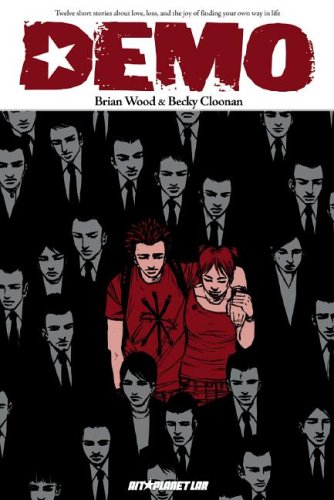
Demo: The Collected Edition by Wood

A collection of stories chronicling the various occurrences in the lives of teenagers.

So, you have the power! Let me know what sounds interesting or what I picked that sounds totally lame in the comments. Thanks, all!