Monday, September 27, 2010

New ALD graphic novels, September 2010

Here are some recently ordered graphic novels at ALD. Click on the links below and put them on hold so you can get them when they come in! In the case of Doom Patrol and Planetary, the district ordered the entire series.


Creature Tech was written by Doug TenNapel, the author of the quite awesome and previously featured Ghostopolis and the creator of the Earthworm Jim video game series. It involves mad scientists, giant space eels, and a bit of science versus religion philosophy. What else do you need to know?


Warren Ellis' Planetary series follows a band of superhero "architects" who are tasked with uncovering ancient artifacts of the world. Planetary does a better job than most comics exploring who and what superheroes really are.


Doom Patrol is another unconventional graphic novel series that features a strange ragtag group of superheroes in the vein of Moore's League of Extraordinary Gentleman. A human brain in a robot body and Negative Man are only a smattering of Morrison's creative use of superheroes in the series.


Cinderella: From Fabletown with Love is an offshoot of Willingham's popular Fables series. As we know from the Fables series, *minor spoilers* Cinderella is a spy for the Adversary. This graphic novel follows Cinderella's days as a spy a bit more closely.


Batman: The Killing Joke is another one of Alan Moore's critically acclaimed graphic novels. Hailed as one of the best Joker stories of all time and the main inspiration for Joker's appearance and demeanor in The Dark Knight, this is one Batman story that should not be missed.

Saturday, September 11, 2010

Eternals by Neil Gaiman - September 26th


Eternals is a reboot of a 1970s Jack Kirby series of the same name. The Eternals are a small group of gods whose job is to protect the Earth. In classic Gaiman fashion, he takes an obscure superhero and puts his own mythological spin on it. Gaiman introduces the reader to the Eternals universe by putting you in the shoes of Mark Curry, a harried medical student. When Curry meets a man who claims to be an ancient superhero named Ikaris who has known him for thousands of years by the name of Makkari, the saga has only begun.

Some general thoughts on Gaiman's Eternals from our book clubbers:

-Wasn’t very good because Gaiman was too enamoured with Kirby’s original series. Limited himself too much.

-We liked the mystery and grandeur of the story, but were disappointed by the fact that immortal gods still have miniscule emotional problems

-Eternals needed to be independent of the universe, don’t have to deal with Marvel characters or crossovers

-Seems like the motivation for this comic could have been a capitalistic gain, with the huge Gaiman letters on the cover

1. Gaiman tends to reuse ideas and themes in his work. Are there any similarities or differences between Eternals and Sandman or American Gods or Neverwhere?

Gaiman's modus operandi is reviving obscure superheroes (possibly to keep Marvel/DC's copyright recent?) and making them relevant for a new generation. He also loves mythology and talking about gods, as evidenced in American Gods and Sandman. It seems in Eternals, Gaiman was limited to Kirby's mythology, arguably too much, speaking of the "space gods" that are the Eternals. Taking a page from Neverwhere, Gaiman takes an everyman in Mark Curry and throws him into a strange world not unlike our own. The difference here, as mentioned before, is that Gaiman is held back; either by Marvel's rules or by his own allegiance to Kirby's original story.

2. What are the advantages and disadvantages of doing a reboot of an older comic (like Sandman for example), such as this one adapted from Kirby's work?

Jeremiah argues that this is not a reboot and more of a retconned sequel. (Retcon meaning retroactively fitting the story and characters into an already existing storyline). Rather than a reimagining the Eternals, Gaiman is continuing the characters from Kirby's story; it’s more like a sequel. The advantage to doing a reboot, obviously, is that the writer doesn't as creative since a framework is already built an audience is already built in.

3. How did you feel about the origin and purpose of the Eternals, being ancient ones who protect the Earth?

The story has it that the Eternals are wired to protect the Earth, as boring as that sounds. So the purpose of the Eternals is not terribly interesting. The origin, in the Antarctica-esque earth coffins, is a bit more interesting, but too convoluted for this reader to fully understand.

4. Is there any deeper commentary or meaning on Gaiman's satire of reality television with It's Just So Sprite and America's Newest Superheroes?

It's Just So Sprite is significant only to introduce the reader to Sprite, and later find out that he is an Eternal and used his power to become famous. America's Newest Superheroes seems to be a vehicle just for Gaiman to poke fun at reality television and superheroes in general.

5. What are your thoughts on using amnesia as a plot device, especially in Sprite's plan and with the character Mark Curry?

This isn't any amnesia, this is God-induced amnesia. Super amnesia if you will. However, that doesn't make it any better a plot device. Amnesia is a decent way to introduce us to Mark Curry and his transition into becoming an Eternal, but Sprite's amnesia-induced hypnotism on the rest of the Eternals was lame retconning at its finest.

6. One of the challenges of being a non-independent comics writer is writing recent universe plot developments into the story. How does Gaiman tackle this? Do you think universe continuity is important in comics?

Unfortunately, Gaiman wrote Marvel's Civil War storyline into Eternals, so there's bare bones talk about registering as a hero from Iron Man. However, this inclusion enriches neither this graphic novel or Marvel's series. In the case of Eternals, I think it would have been better all around if Gaiman was able to ignore the Marvel Universe all together and have free creative reign to do what he wants. Keeping with continuity in comics is an art that few writers have, all too often storylines end up being ridiculous, retconned, and/or convoluted like One More Day.

7. Kirby's original Eternals series was originally not supposed to be a part of the Marvel Universe and was later brought into continuity. Would the Eternals be better off in their own world?

See previous question.

8. Graphic novels such as Watchmen, Eternals, and Kingdom Come are superhero deconstructionist graphic novels, meaning they redefine or question the superhero archetype. How does Eternals deconstruct what superheroes are currently made out to be? Are superheroes gods?

As Jeremiah so eloquently pointed out, Eternals is not quite a deconstruction. Superhero deconstructionist stories ask why superheroes do what they do and why society allows it. In this case, it is clear what the Eternals have to do. Protecting the Earth is their job. It is almost the opposite the Eternals can’t change. They are like robots, or a system. “We MUST protect.”

9. Why did Sprite do what he did? Would you have done the same thing if put in his situation?

In this book club's opinion, there was very little reason given. Just being eleven for eternity doesn’t seem to be the major factor. Sprite didn’t know the consequences of his actions. He’s been alive for so long, he doesn’t think any bad things were going to happen.

10. What is the purpose of having the Eternals in the Marvel Universe? Is there any significance to the timing of this comic, since it was set during the Civil War storyline?

See # 6. The short answer: little to no purpose and none, other than capitalistic gain.

11. Why are the Eternals compelled to protect the human race if they are not human themselves?

The Celestials told them to do so, the Eternals are hardwired to protect Earth. The book club made a comparison to Greek gods on Olympus - the lives of the humans are insignificant to them, but watching their existence, however meager, is all the gods have have to entertain themselves or keep busy. It could be argued that the Eternals are not involved in human struggles they are more motivated to save the Earth. Earth's inhabitants are only secondarily served.

12. Are the Eternals too powerful to be a part of an interesting storyline? Is this perhaps why they've never had a long-running series?

Yes, as far as a traditional comic story goes, which it is limited to in the Marvel universe. Again, gods are difficult to relate to. A better story would be less about them, more about internal struggle. Readers need something relatable to care about what is going on.

13. How did you feel about the ending of Eternals? Some criticize the graphic novel and its ending for feeling like a set up to simply put the Eternal heroes into the Marvel Universe.

The ending seemed unfinished and a start to a miniseries that never got enough attention to go anywhere. So, as it stands, with no continuation of the Eternals in the Marvel Universe, it could be argued that it was a standalone with an ambiguous ending or a failed launch of a new superhero series.

Monday, August 16, 2010

Future graphic novel selections January - April

Hey all, we need to narrow this list down to four that we want to read for the January, February, March, and April book clubs. Here are some that I came up with, feel free to suggest others and/or weigh in on which of these you would like to read or not read.

Kingdom Come by Waid

A Watchmen-esque post apocalypse story that dissects and analyzes the role and the importance of superheroes like Batman, Superman, and Wonder Woman.

Ghostopolis by TenNapel

Garth Hale has traveled into the spirit world and must enlist the help of a few apparitions to escape.

Johnny the Homicidal Maniac by Vasquez

Invader Zim creator Jhonen Vasquez gives us a comic look into the world of Johnny the Homicidal Maniac, who gleefully tortures his victims and terrifies a young boy named Squee.

Stitches by Small

A memoir on children's author David Small that chronicles his troubled life with his parents and the partial loss of his vocal cords.

Planetes vol. 1 by Yukimura

A hard science fiction comic that follows a spaceship crew whose job it is to collect space junk.

Akira vol. 1 by Otomo

The work that inspired the anime, Akira is a six part epic that involves psychic children being used as weapons of mass destruction.

Swamp Thing vol. 1: Saga of Swamp Thing by Moore

A famous 1980s run of Swamp Thing that brought horror comics and mature comics to the forefront.

Blankets by Craig Thompson

Thompson's semi-autobiographical sometimes tragic, sometimes comic tale of first love.

Superman: Red Son by Millar

A highly acclaimed alternate universe tale in which Superman was not born in Smallville, Kansas, but in Soviet Russia.

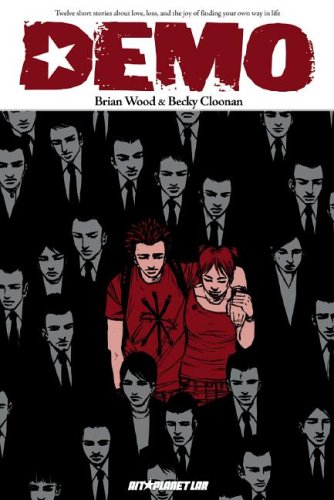
Demo: The Collected Edition by Wood

A collection of stories chronicling the various occurrences in the lives of teenagers.

So, you have the power! Let me know what sounds interesting or what I picked that sounds totally lame in the comments. Thanks, all!

Monday, August 9, 2010

Black Hole by Charles Burns - Questions & Answers


Have you ever flipped through a graphic novel and said, "WHOOOAAA, what's going on in that panel?" Every other page or so of Black Hole is a "WHOOOAAA" page. Burns' beautifully illustrated work took him ten years to complete and it shows. The drawing style is almost instantly recognizable to the point that he has regular gigs drawing covers for magazines and advertisements.

Black Hole is set in Seattle in the 1970s and chronicles the lives of four teenagers. Sex, drugs, STDs, sex, and drugs are abound. This is the most adult graphic novel we've read so far, at least from a surface viewpoint. It's also a great book club choice if I do say so myself because some plot elements are ambiguous and there are symbols and motifs on every page. Burns is much like the other author/illustrators we've read (Mike Mignola, Jeff Smith); their graphic novel(s) took years to complete, but turned out to be a critically acclaimed work of art.

Here are the questions and answers that were discussed at the graphic novel book club at Koelbel on August 29th. Thanks to everyone for contributing.

1. What is the significance of the woods?

Those who are infected with Bug are sent to the woods where they can hide in peace and be independent and isolated. It is where they felt they should be, the woods are a representation of their choice to banish themselves from society. Trashing the house later in the book means the infected are recreating an atmosphere more like their home into the woods.

2. What is the importance of yearbooks?


The front and back cover feature before (normal) and after (infected) pictures, a representation that nothing is simple and these aren’t just happy teenagers. Even the kids who don’t have the Bug still have things going on behind the scenes. The pictures are frozen, posed, and superficial, only representing the surface of who these kids are. Yearbooks are not representative of who people are/were inside and what they do.

3. Why was Black Hole set in the 1970s? What commentary is made on the generation?

Parents are more involved this generation and there's arguably more societal pressure to go to college and get a job. It’s less relatable to people of Generation Y. The 1970s culture was full of drugs and sex, the perfect atmosphere for Burns to use to comment on what was going on with teenagers then.

3a. What if these events had occurred to teenagers now? How would they react?

Arguably, kids have more awareness about STDs and more access to information on the Internet, so a widespread STD such as Bug would be less likely to occur. This generation also does not have the "free love" attitude that carried from the sixties into the seventies, so perhaps the STD would be less widespread.

4. How did you feel when you were reading Black Hole? Was this the author's intent?

Confused, grossed out, concerned. Depressed. Infected or dirty, it gets under your skin. The combination of Burns' super realistic drawings and surreal creepy drawings made for an uneasy feeling.

5. How does Burns distort fantasy and reality? What role did dreams play?

Jeremiah says dreams are surprisingly well portrayed, he feels that dreams run into reality much like how Burns illustrates them. Dreams were used to inject important symbols and ideas into the story. The reader is never quite aware what events are fact or fiction while reading Black Hole.

5a. Compare the way dreams are portrayed in graphic novels to other mediums.

Dreams are much more effective in graphic novels, the authors don’t have to spend all kinds of time explaining the scene as they would in a book. Unlike other comics or mediums, Black Hole's artistic style is the same in dreams and reality, the content is just different. They don’t change colors or lines like they do in other mediums so the transition feels more natural.

6. What is the significance of water? Why do the infected seem drawn to it?

Traditionally, water represents birth and purification. Swimming makes Chris feel better, perhaps its the only place she can truly feel clean. Erika suggests that puddles and diffusion can change and distort an image, so perhaps Burns is playing with the parallel of the distorted physical manifestations that are found on the infected.

7. Describe Burns' art style. Why did he choose to illustrate Black Hole this way? Is there any feel he was trying to evoke?

Burns' style is instantly recognizable and consistent. In this book, he chooses to draw quite realistic people with unsightly features such as unibrows, pimples, and partial mustaches. This provides a stark contrast between the science fiction-esque imagery and the realistically drawn characters.

8. Would Black Hole be better/worse in color? Why or why not?

I think drawing Black Hole in color would take an already disturbing and grotesque graphic novel over the top in terms of tolerance. Burns' style is already so emotive and impressive that color is not needed.

9. How is Black Hole different from other critically acclaimed "hipster" comics such as Jimmy Corrigan?

Other "hip" graphic novels such as Ghost World and Jimmy Corrigan, which are essentially non plot driven studies in human tragedy, are different from Black Hole. Elena argues that the characters in Burns' work have some chance at redemption and both character and plot progress are made. We also wonder if this and other graphic novels are so critically acclaimed because they are esoteric so a critic gives it a good score to keep from looking stupid.

10. Is there any significance to the absence of parents in this graphic novel?

It represents that nobody cares about anyone else. In this generation, parents are more involved and kids are pushed more towards success. In the 70s, it was more hands off parenting. It seems at least in Black Hole that parents are willing to overlook, don’t want to get involved.

11. What is the importance of Eliza and Keith escaping to the desert at the end?

A desert is the complete opposite of a wet and tree-filled Seattle. Perhaps such a dramatic physical change of environment can help these two forget the horrific occurences back in Seattle.

12. What is the significance of the conversation between Rob and Chris before they first have sex?

The conversation is a play on the embarrassment of being a virgin versus the embarrassment of having an STD. Rob wants to tell Chris he's infected, but she thinks he's talking about being a virgin, so she tells him not to worry about it. This is representative of the lack of responsibility and communication teenagers have and how easily an epidemic like this could spread.

13. What do the mutations caused by Bug represent? Each mutation seems to vary depending on the person (tail, mouth, face, etc.). Why?

We didn't really get to this one in club, I'm hoping to hear some of your thoughts on it. Jeremiah argues that Rob's neck mouth says his unconscious thoughts and fears, but what does the tail or any other deformations represent?

14. What is the difference between the "normal" kids and the infected kids? What does this represent?


The "normal" kids are mostly burnouts and drug users while the infected tend to be a bit more inclusive. However, there's a complete lack of any truly "normal" characters in Black Hole. Where is the football team, the cheerleaders? Burns chose to represent a few factions, both of whom could be argued to be equally deviant.

15. Neil Gaiman was writing the screenplay for a movie adaptation, but he left the project in 2008. David Fincher (Fight Club, Curious Case of Benjamin Button) is still set to direct. What do you think of Hollywood's tendency to adapt every popular graphic novel into film? Would Black Hole adapt well?

The combination of Gaiman and Fincher could have been perfect, but now the future of the project looks uncertain. The current tendency towards superhero movies also makes the project a rough start. If the director was not careful, the film could be ridiculously campy and not purposely funny. It could detract from the real message.

16. Black Hole offers little plot resolution in the end. Is there any reason for this? Is there emotional resolution?

We didn't get to this one, either. Thoughts?

Monday, July 26, 2010

Orbiter by Warren Ellis - Questions & Answers


The graphic novel book club selection for August 1st was Orbiter by Warren Ellis. Orbiter is Ellis' love letter to astronauts and the space program. He was inspired by the 2003 Columbia disaster. It is a very quick hard sci-fi read. Technical jargon is dropped throughout the graphic novel. Apparently, understanding said jargon helps the reader comprehend some elements of the book, but is not totally necessary.

Much of the intrigue of the graphic novel revolves around the mystery of astronaut John Cost, who returns to Earth from a previously thought doomed shuttle launch. Cost is catatonic through most of the book and the ending both raises and answers questions. Since I have not previously read any Warren Ellis graphic novels, I can't compare. However, judging from various reviews, this is not standard Ellis fare. All in all, an enjoyable read.

Here are the somewhat *SPOILERY* discussion questions and answers. Thanks to our book clubbers, including Erika, Richard, Jeremiah, Elena, Jan, Josh, Vrlina, and Nick (me!) for the answers and discussion.

1. Warren Ellis seems to be interested, maybe obsessed with astronauts and space. How does this show in his writing? How does it affect the story?

The entire book is indeed a love letter to space, this is especially clear in the foreword to Orbiter in which Ellis laments the uncertain future of the space program since the 2003 Columbia disaster. In fact, Orbiter was apparently on the back burner and Ellis and Doran decided to unleash it on the world after the Columbia disaster, so perhaps this affected the storytelling and message behind the book.

2. What recent political occurrences could have influenced Orbiter? What if the graphic novel was written now?

Most likely due to the recession, Obama has deemphasized the space program. Rumor has it, the current space project could be the last for a while. Elena posits that Ellis could be working on Orbiter 2 as we speak. (Which she would not be very happy about).

3. Why did Ellis choose to set Orbiter in a post-apocalyptic world? Is the post-apocalypse setting used too often in graphic novels?

Orbiter isn't necessarily post-apocalyptic. The beginning of the book would have you think so with the tent city and the state of the Kennedy Space Center, but news casts and current technology are available. That said, though, the post-apocalypse theme is getting a bit worn.

4. Orbiter is a rare occurrence in comics - a hard science fiction tale. Are there other graphic novels that fit into this genre? Why aren't there more hard science fiction comics?

It could be argued that Y the Last Man is hard science fiction. The only other series I can think of is a nice little manga called Planetes. I think the market for hard sci-fi graphic novels hasn't been found yet. As Richard and Jeremiah discussed with us, graphic novels are often used for crazy ideas, like a real world full of fairy tale characters. Maybe authors have not found the hard science fiction graphic novel niche yet.

5. Why does John (the returned astronaut) keep having violent reactions to the psychiatrist and conversations about his experience?

It is mentioned briefly at the end that the aliens showed John some things he was not ready to see, so this could have resulted in such shock. The man was also alone on a space ship with nothing to think about but these aliens and the unbelievable things he'd seen. The violent reactions remain a mystery, anyone care to weigh in there? John also gets off scot free at the end of the book when he leaves again, everyone seems to ignore the violence and death he caused.

6. Did the technical jargon used throughout Orbiter detract from the story? Add?

It added an element of realism and believability. Although we did not understand everything being said, we felt the jargon added.

7. What is your opinion on Terry and Ali's romance at the end of the book?

Tacked on, cheesy. In fact, the entire end of the book with everyone being gung-ho about leaving everything behind including their loved ones and life on Earth to go visit some aliens who have magic purple goo. Jack of Fables lookalike Terry and Ali's romance just seemed to be reaching for the unnecessarily mega-happy ending, Wayne's World style.

8. Orbiter is dedicated to the astronauts who lost their lives in the 2003 Columbia disaster. After the disaster, the shuttle program was suspended. Is space exploration worth the risk to human life and spending of government money? How do the themes of Orbiter play into this?

Warren Ellis obviously thinks that space exploration is worth it. This was a big point in our book club. Jeremiah argues that unmanned technology such as the Hubble and Mars rovers can help us learn as much if not more about space than the much more dangerous manned spaceflight. It seems that manned spaceflight hearkens back to the days of Magellan and Christopher Columbus, man just wants to conquer the unknown and call it his own. Clearly, Orbiter illustrates that space exploration has tangible mental and physical effects on astronauts. If Ellis was not so biased and one-sided in his view on space (SPACE IS GOOD!), perhaps the argument could be made that Cost is used as a commentary on the negative effects on returned astronauts.

9. What is Anna's motivation in being a therapist for astronauts? Why is this important?

We felt Anna was a bit of an unnecesary character, it seems she was only used so that she could finally get John Cost to talk again. She was also a weak plot device to have each character describe their love/motivations for space. Anna wants to hear the stories of astronauts and live vicariously through them, etc.

10. Why is John Cost catatonic upon his arrival to Earth?

See #5. I sometimes write redundant questions.

11. Why did the other astronauts send only John back to Earth on a ten year journey?

Elena believes John was a martyr. His job was to go back to Earth and tell the world of the beneficial aliens who want to "play" aka travel in space. Elena also argues that John could be lying about the whole thing. Do we believe one (formerly bloodthirsy and crazy) astronaut? Would you jump on a ten year old ship with an unstable astronaut and a Jack of Fables lookalike to visit some aliens who want to "play?"

12. What are the implications of alien technology on human spaceflight? Alien technology allowed the Venture astronauts to truly explore space. What will happen to the space program now? Will humans somehow adopt the alien technology?

No one but the army general is skeptical about the alien technology. How does anyone know it is worth the risk? Maybe the aliens do mean humans harm. Everyone seems completely willing to take this risk for the chance to travel space. The alien technology also makes future space programs pointless. If we've already seen the purple goo technology that allows for unlimited spaceflight, why would we go back to our faulty shuttle screws and missed calculations?

13. What is the importance of Dave Stewart's color palette? How does Colleen Doran's style fit with the story?

The color palette is brown and earthy. Maybe this is a contrast, to show the bright and radiant purples and blacks of outer space? Doran takes a very realistic art style for the story, to fit with the science and logical aspects of the plot.

14. Warren Ellis says in his foreword, "It's a book about glory. About going back to space, because it's waiting for us, and it's where we're meant to be." Do you agree with this statement? Are we meant to be in space? Is Ellis' agenda pushing through an otherwise honest message?

Elena's answer was too good not to quote, "His agenda IS his message, completely transparent and not very much fun. If we were meant to be in space, we would have wings and rocket feet and space gills. The message is honest and heartfelt, but lost on the likes of me." I agree to an extent. As previously mentioned, Ellis' message/agenda is clear and unchanging. We were not meant to be in space, but I do think we're meant to explore the unknown and I think humanity finds something fascinating in that.

15. Many reviewers criticize Orbiter for its sudden ending. What is your opinion on the ending?

Many of us thought it was abrupt. I remember getting to the last few pages and wondering, "how is Ellis going to wrap all of this up with so little space left?" Despite the abruptness, I felt it tied up what needed to be tied up and I believe that the ambiguity was interesting.

That's it! Thanks for coming to the book club, everyone. Let's keep the discussion going in the comments section.

New ALD graphic novels, July 2010


Let's get this blog started with some graphic novels that ALD has ordered recently! Below are links to the library record for each graphic novel. Put them on hold and experience the glory of free comics all year around.

Locke and Key: Crown of Shadows is a relatively new series by horror author Joe Hill. The story follows Ty, Bodie, and Kinsey who struggle to combat their teenage years AND ghostly apparitions. This is the third trade in the series, hopefully it will let readers know about the mysterious Omega Key that's been hinted at in the first two books.

Scott Pilgrim is a hilarious manga-styled comic that chronicles the adventures of, you guessed it, Scott Pilgrim. The series has experienced a resurgence of popularity, largely thanks to the upcoming film adaptation starring Michael Cera. The series features a bunch of clever video game-based jokes.


Mike Mignola is no stranger to work and he's continuing the Hellboy series with Hellboy 10: The Crooked Man and Others. When we last saw Hellboy, he was found to be involved in some crazy Arthurian legend which by my guess will be a jumping off point to wrap up the series in an epic conclusion. This volume of Hellboy is sure to feature what all Hellboy trades have in abundance: face punching, confusing mythological references, and the colors red and black.

After the somewhat controversial The Great Fables Crossover, which saw the Fables series and the Jack of Fables series, uh, cross over, Bill Willingham is continuing Jack's spinoff story in Jack of Fables 7: The New Adventures of Jack and Jack . I'm not caught up on Jack's story, but you can be sure there will be self-referential literary jokes, a blue ox, and all kinds of Jacks from fairy tales including Jack Frost.